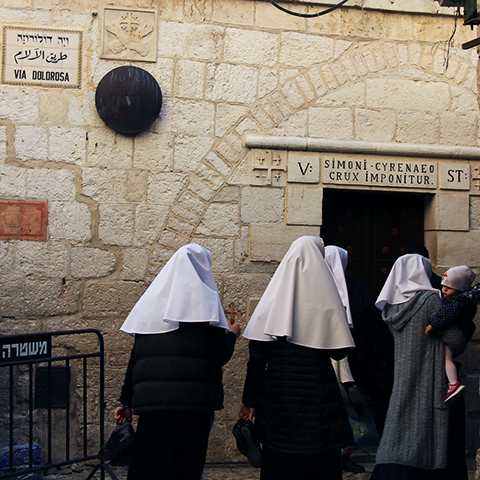
Walk the traditional path of Jesus through Jerusalem’s Old City, following the Stations of the Cross from the Antonia Fortress to the Church of the Holy Sepulchre. Explore each station with the interactive map, historical background, and biblical references. Some stations are based on events described in the New Testament, while others come from later Christian tradition.
Read more about the tradition of the Via Dolorosa
The modern form of the Via Dolorosa developed over many centuries of Christian devotion, especially during the medieval period and through the influence of the Franciscan Custody of the Holy Land. Pilgrims in Europe created the tradition of the “Stations of the Cross” to spiritually follow the journey of Jesus’ Passion, even without being physically in Jerusalem.
When this tradition was later applied to Jerusalem, the route and its stations were gradually connected to specific places in the Old City. However, not all stations are described in the New Testament. Some, such as the three falls of Jesus and the story of Veronica wiping Jesus’ face (Station 6), come from later Christian tradition rather than the biblical text.
The current form of 14 stations was gradually standardized and later recognized in Catholic tradition, influenced over time by church authorities including the Vatican. The goal was not strict historical reconstruction, but a devotional path to help pilgrims reflect on the suffering and journey of Jesus.
Today, the Via Dolorosa combines biblical events, traditional sites, and centuries of Christian devotion, creating a spiritual route that continues to guide visitors through Jerusalem’s Old City.
Google Map with Floating Carousel
The Stations of the Cross
Jesus is condemned to death
Station 1
Current tradition holds that Jesus was condemned at the Praetorium within the Antonia Fortress overlooking the Temple Mount from its southwestern corner (John 18:28; John 19:16). Today, the site is occupied by Omariyeh College, where entry is not always permitted.
Jesus takes up the cross
Station 2
Two churches are located here: the Franciscan Church of the Condemnation, commemorating the condemnation of Jesus, and the Chapel of the Flagellation, where Jesus is said to have been flogged (John 19:1; John 19:17). Both are within a courtyard across from Station 1.
Jesus falls for the first time
Station 3
Walk west along the Via Dolorosa until you reach a crossroads, then turn left onto El-Wad Road (Ha-Gai). Immediately on your left is Station 3 next to the entrance of the Armenian Catholic Patriarchate Hospice. A relief above the entrance marks the station. This fall is part of later Christian tradition and is not mentioned in the Bible.
Jesus meets his mother
Station 4
Only a few meters beyond Station 3 along El-Wad Road is Station 4, marked by a relief above a double door leading to the Armenian Catholic chapel known as the Church of Our Lady of the Spasm. Tradition holds that Jesus met his mother here. This meeting is not directly described in the Gospels, though Mary is present during the crucifixion (John 19:25).
Simon of Cyrene carries the cross
Station 5
Several meters further down on your right, El-Wad Road again intersects with the Via Dolorosa. At this intersection’s corner stands a small Franciscan oratory marked with the Roman numeral V above the doorway. According to the Gospels, Simon of Cyrene, a pilgrim from what is now Libya, was compelled to help Jesus carry the cross (Mark 15:21; Matthew 27:32; Luke 23:26).
Veronica wipes Jesus’ face
Station 6
Continue uphill along the Via Dolorosa. On your left, just before the Church of St. Veronica, is Station 6, where tradition holds that Veronica wiped Jesus’ face with a cloth. This event does not appear in the Bible and developed in later Christian tradition.
Jesus falls for the second time
Station 7
Continue uphill until you reach the intersection with Beit HaBad Street, one of the main market streets of the Old City. Station 7 is marked above the entrance to a Franciscan chapel. This area marked the western edge of Jerusalem in Jesus’ time, with a gate leading out of the city walls. The second fall is part of later Christian tradition and is not mentioned in the Bible.
Jesus consoles the women
Station 8
After turning left from Station 7 and walking a short distance along Beit HaBad Street, turn right onto Ma’a lot al-Khanqa Street. About 15 meters ahead is a Greek Orthodox convent with a stone marked by a Latin cross. Tradition identifies this as the place where Jesus spoke to the daughters of Jerusalem (Luke 23:27–31).
Jesus falls for the third time
Station 9
Retrace your steps back to Beit HaBad Street and turn right. Continue uphill until you reach a stairway on your right. Climb the stairs and follow the path toward the entrance of a Coptic church. This is the traditional site where Jesus fell for the third time. This event is not mentioned in the Bible and is part of later Christian tradition.
Jesus is stripped of his garments
Station 10
From the Roman column marking Station 9, turn left into the rooftop courtyard above the Church of the Holy Sepulchre. Ahead of you is a very low entrance leading into the Ethiopian church complex. Walk through the church and down the stairs. Exit into the courtyard of the Church of the Holy Sepulchre. On your right are stairs leading to a chapel adjacent to the church, traditionally identified as the place where Jesus was stripped of his garments (John 19:23–24). The chapel is usually closed to visitors.
Jesus is nailed to the cross
Station 11
Enter the Church of the Holy Sepulchre. In front of you is the Stone of Anointing, where tradition holds that Jesus’ body was prepared for burial. From here, take the steep stairs immediately on your right, close to the entrance of the church, leading to the upper landing. Now you are on Golgotha, the traditional place of the crucifixion. The nave on the right is a Franciscan chapel marking the site where Jesus was nailed to the cross (John 19:18; John 19:17; Luke 23:33).
Jesus dies on the cross
Station 12
The left chapel is the Greek Orthodox Chapel of Golgotha. Beneath the altar is the rock traditionally identified as the place where Jesus died on the cross. Many visitors bow down or reach under the altar to touch the rock beneath (Matthew 27:50–54; Mark 15:37–39; Luke 23:46). During peak seasons, this area can become crowded, and it may take some time to reach the altar.
Jesus is taken down from the cross
Station 13
Between Stations 11 and 12 stands a statue of the Virgin Mary marking the traditional site where Joseph of Arimathea took down the body of Jesus from the cross after the crucifixion (Luke 23:53; John 19:38).
Jesus is laid in the tomb
Station 14
From Station 13, return down to the main entrance area level. Pass the Stone of Anointing and continue toward the Rotunda. In the center of the Rotunda, surrounded by large columns, stands the Aedicule, the shrine traditionally identified as the burial place of Jesus (Matthew 27:59–60; John 19:41–42).
Follow the line of visitors toward the entrance of the tomb itself. During peak seasons, the queue can be very long, and waiting times of over an hour are common before entering the tomb.
The outlook from the Mount of Olives offers one of the most iconic and breathtaking views of Jerusalem. From this elevated point, visitors gain a deeper understanding of the city’s history and its role as a holy center for faith and tradition.
Mount Gilboa
Mount Gilboa rises above the Jezreel Valley as the setting of one of the most dramatic moments in the Bible. According to 1 Samuel 31, it was here that King Saul, wounded in battle and seeing his sons — including Jonathan — lying slain in the valley below, fell on his own sword to avoid capture by the Philistines. Their bodies were later taken and hung on the walls of Bet She’an, visible from the slopes of the mountain.
This event is more than a battlefield tragedy—it marks a pivotal turning point in the biblical story. It reflects the complex relationship between Saul and David, the deep bond between David and Jonathan, and the divine choice to anoint David as the next king of Israel. In the following chapter (2 Samuel 1), David mourns Saul and Jonathan with a heartfelt lament: “How the mighty have fallen…”
This moment also marks the beginning of the rise of the House of David, the royal lineage of Israel’s future kings. Standing at Mount Gilboa, surrounded by the same landscape described in the Bible—the mountain, the valley, and nearby Bet She’an—you can feel the story come alive through the geography and the echoes of the ancient past.