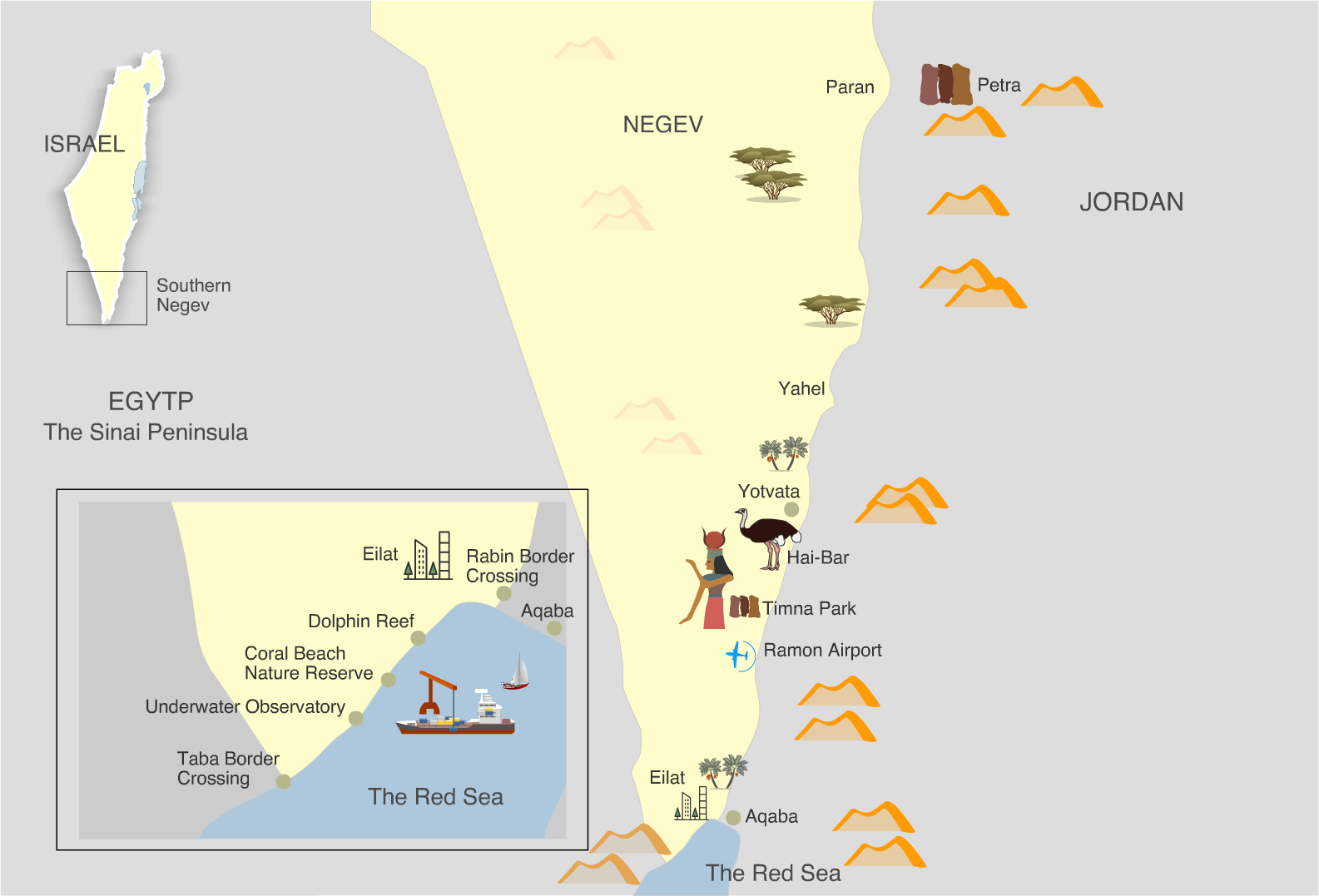
Map of the Southern Negev

The Southern Negev is where Israel’s desert reaches the Red Sea. At its southern edge lies Eilat, known for attractions such as the Coral Beach Nature Reserve, Dolphin Reef and the Underwater Observatory. Nearby are the Hai-Bar Yotvata Wildlife Reserve and the dramatic desert landscapes of Timna Park. The region also includes Israel’s southern border crossings to Egypt and Jordan, used by travelers moving between the Red Sea resorts and neighboring countries.
Timna Park

Hi-Bar Yotvata

Southern Negev

Timna Park

Hai-Bar Yotvata Wildlife Reserve

Dolphin Reef
A unique seaside site in Eilat where dolphins live in a natural lagoon connected to the Red Sea. Unlike most dolphin parks, the dolphins are free to swim out to the open sea and return. Visitors can watch them from piers or join guided snorkeling and diving experiences.

Coral Beach Nature Reserve
A protected stretch of the Red Sea reef in Eilat where visitors can snorkel above colorful corals and tropical fish. Wooden walkways lead to the water, allowing easy access to one of the northernmost coral reef systems in the world.

Underwater Observatory
One of Eilat’s most famous attractions. A tower built over the Red Sea reef allows visitors to descend below the surface and observe coral and marine life through large viewing windows without getting wet.

Petra (Jordan)
Petra is a famous archaeological site located in Jordan. This ancient Nabataean city was carved into the red sandstone cliffs and is known for its impressive rock-cut temples and tombs. Visitors staying in Eilat can buy organized tours to Petra. Because of the relatively short distance, many travelers visit on a one-day trip, while others choose to stay overnight and spend more time exploring the ancient city. The visit requires crossing the border and obtaining a Jordanian visa.

Google Map with Floating Carousel

Timna Park

Egyptian Copper Mines and the Pillars of King Solomon

Site 1

About 25 km (15 miles) north of Eilat lies Timna Park, one of the most fascinating landscapes in the southern Negev. The park combines dramatic desert geology, ancient copper mines and striking sandstone formations.

Visitors come to see the famous Solomon’s Pillars, towering cliffs that became linked in tradition with Solomon, and other natural formations such as the Mushroom and the great desert arches. Timna is also known for some of the earliest copper mines in the world and for the colorful mineral called Eilat Stone.

A modern visitor center is the most natural place to begin your visit. It introduces the geology and long history of the valley. From there the park can be explored by car along a scenic route, but many visitors also choose to walk the area on both short and longer desert hiking trails. Some travelers even stay overnight in the park to experience the quiet desert and the clear night sky.

Timna Valley lies in a wide desert basin surrounded by steep cliffs and colorful rock layers. Over millions of years wind and water shaped the soft sandstone into dramatic formations. The red and golden sandstone landscape in parts of Timna is similar to the rock formations seen in Petra, creating impressive desert scenery.

Among the most famous formations are Solomon’s Pillars, the Mushroom, and several large natural arches rising from the desert floor.

Timna is also one of the oldest copper mining regions in the world. Archaeological discoveries show that copper was extracted here more than three thousand years ago. During the Egyptian New Kingdom period, miners and metalworkers operated large mining camps in the valley.

Remains of smelting furnaces, ancient shafts and mining installations can still be seen today. Near Solomon’s Pillars archaeologists discovered the small Hathor Temple Timna, dedicated to the Egyptian goddess Hathor, protector of miners. The temple was built beside the towering sandstone pillars and decorated with reliefs of the goddess.

The structure of this desert shrine, with an open courtyard and an inner sacred space, reflects a temple layout that later appeared throughout the ancient Near East, including the design associated with the Solomon’s Temple.

Some researchers have suggested that copper produced in the Timna mines may have been transported north through desert routes to the Red Sea port of Ezion-Geber, which the Bible associates with the reign of Solomon. From there ships sailed toward distant lands, linking the copper of the desert with the wider trade networks of the ancient world.

Another treasure of Timna is Eilat Stone, a rare copper mineral known for its deep blue and green colors. It is a natural mixture of several copper minerals and was mined in the region in modern times. Because of its striking colors and its connection to the copper mines near Eilat, the stone became popular in jewelry and decorative objects.

Today Timna Park is both a geological reserve and a historical site. The visitor center presents the story of the valley, from ancient copper production to the natural forces that shaped the desert landscape.

Hi-Bar Yotvata: Desert Wildlife Reserve

Site 1

Behind a long fence along the desert road, when driving north or south on the way to or from Eilat, you may notice animals moving across the open landscape. These belong to the nearby Hai-Bar Yotvata Nature Reserve.

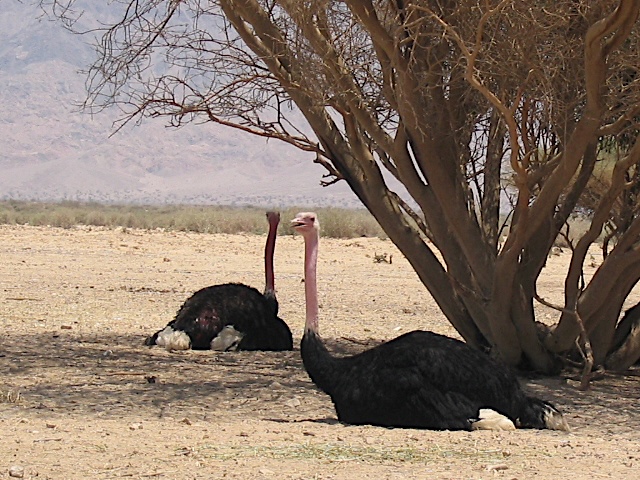
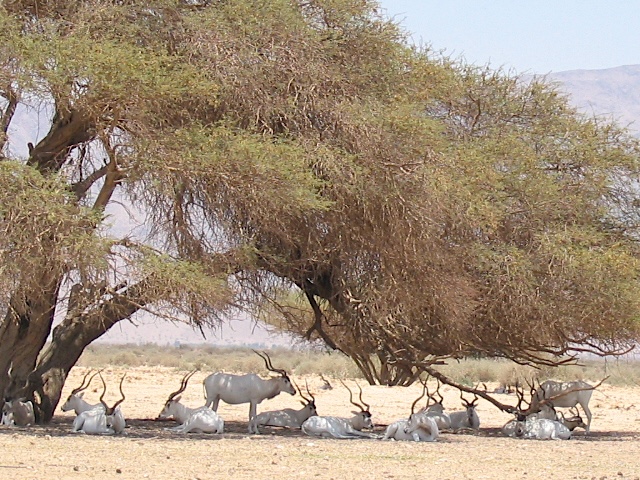
From the road you might catch a glimpse of antelopes, ostriches, or other desert animals roaming in wide enclosures. Many travelers simply pass by and see them from a distance. But the reserve can also be visited, allowing you to drive inside a much larger protected area and explore a small nearby zoo that presents desert wildlife up close.

The Hai-Bar Yotvata Nature Reserve was established by the Israel Nature and Parks Authority as part of a project to restore animals that once lived in the deserts of the region.

Over the centuries many species disappeared from the area due to hunting and changes in the environment. The reserve works to breed and protect these animals and, when possible, release them back into the wild.

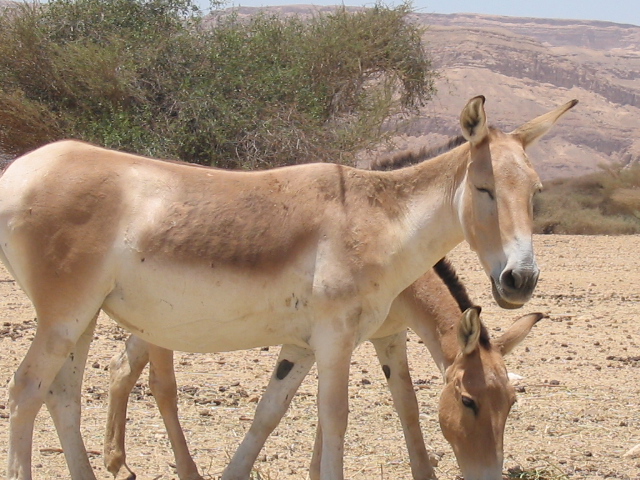
Among the animals raised here are the Arabian oryx, the Persian fallow deer, ostriches, and the Asian wild ass. Some of these species have already been successfully reintroduced into protected areas across Israel.

The reserve itself has two parts. One is a large open safari area where visitors drive through the desert landscape while animals roam in wide spaces. The second is a smaller wildlife park where visitors can walk along shaded paths and observe additional desert animals at closer range.

Set in the quiet scenery of the Arava desert, the reserve offers a glimpse of wildlife that once roamed this land thousands of years ago. For travelers heading toward Eilat or north through the Arava, it can be either a surprising sight along the road or a worthwhile stop to explore.

Mount of Olives

The outlook from the Mount of Olives offers one of the most iconic and breathtaking views of Jerusalem. From this elevated point, visitors gain a deeper understanding of the city’s history and its role as a holy center for faith and tradition.

Mount Gilboa

Mount Gilboa rises above the Jezreel Valley as the setting of one of the most dramatic moments in the Bible. According to 1 Samuel 31, it was here that King Saul, wounded in battle and seeing his sons — including Jonathan — lying slain in the valley below, fell on his own sword to avoid capture by the Philistines. Their bodies were later taken and hung on the walls of Bet She’an, visible from the slopes of the mountain.

This event is more than a battlefield tragedy—it marks a pivotal turning point in the biblical story. It reflects the complex relationship between Saul and David, the deep bond between David and Jonathan, and the divine choice to anoint David as the next king of Israel. In the following chapter (2 Samuel 1), David mourns Saul and Jonathan with a heartfelt lament: “How the mighty have fallen…”

This moment also marks the beginning of the rise of the House of David, the royal lineage of Israel’s future kings. Standing at Mount Gilboa, surrounded by the same landscape described in the Bible—the mountain, the valley, and nearby Bet She’an—you can feel the story come alive through the geography and the echoes of the ancient past.

Interactive map of Jerusalem Old City with religious and historical landmarks
Skip to content