Israel Discoveries
New discoveries, stories, and fresh perspectives on the history and sites of Israel.
St. Mark’s Church
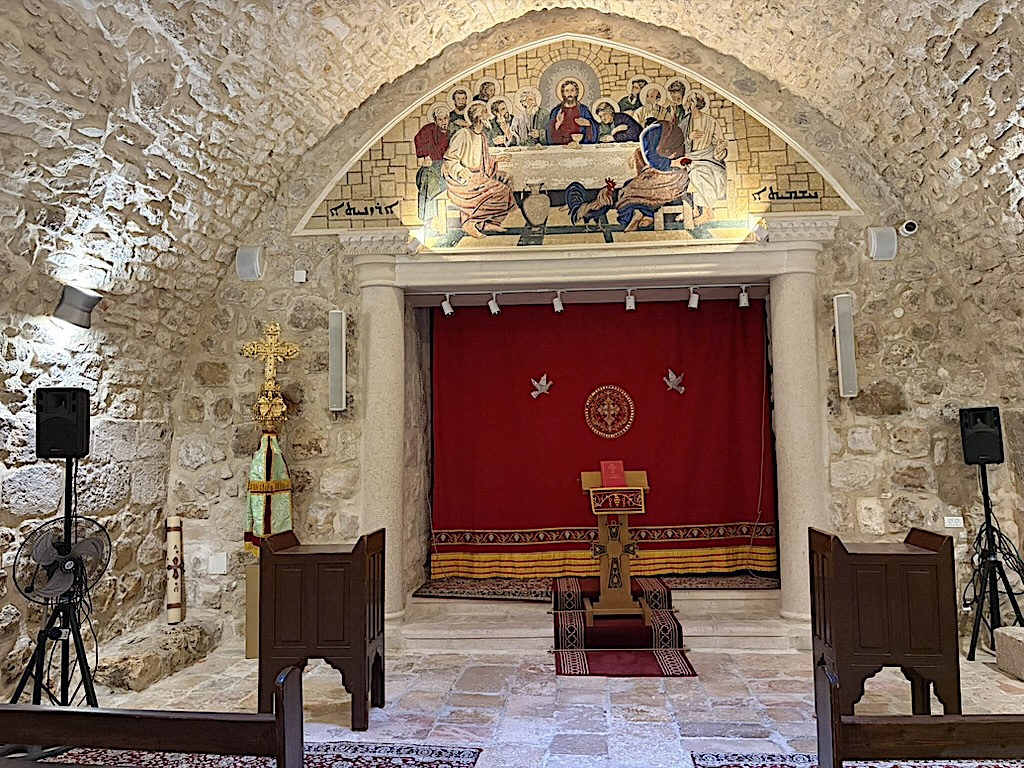
If you have already walked through the Old City and visited its traditional highlights, but still have some time to discover something less familiar, St. Mark’s Church is worth a visit.
I recently visited St. Mark’s with my friend and fellow licensed tour guide Murray Allon, who introduced me to Deacon Michel George Zanbil, one of the church’s deacons.
Hidden away in the Armenian Quarter, this small church is connected to an ancient Syriac tradition and to the story of the Last Supper. It is one of those places that is easy to miss, yet opens another window into the history and traditions of Jerusalem.
What Makes St. Mark’s Church Interesting?
What really makes St. Mark’s Church interesting is its connection to the story of the Last Supper and to one of the earliest gatherings of the followers of Jesus in Jerusalem.
According to Syriac tradition, this is the house of Mary, the mother of John Mark. John Mark is mentioned several times in the New Testament. He was the son of Mary and later traveled with Paul and Barnabas. He is traditionally identified with Mark, the author of the Gospel of Mark.
Continue reading
The Book of Acts tells us that after Peter was released from prison, he went to “the house of Mary the mother of John, also called Mark,” where the followers of Jesus had gathered and were praying (Acts 12:12).
At this early stage, the followers of Jesus were Jews who believed he was the Messiah. Christianity had not yet emerged as a separate religion.
The Syriac tradition goes further. It identifies this house with the place where Jesus and his disciples gathered for the Last Supper. The exact location cannot be established with certainty. Jerusalem has been destroyed and rebuilt many times, and later buildings can hide what remains of the ancient city.
This makes the archaeology of St. Mark’s especially interesting. Excavations carried out at the site uncovered ancient remains and coins dating to around the time of Jesus, including a coin from the reign of Herod Agrippa I. The finds do not prove that the Last Supper took place here, but they do show that this was a place of activity in the very period described in the New Testament.
The ancient tradition, the biblical connection, and the archaeological remains come together to make St. Mark’s one of the more intriguing places to explore in Jerusalem.
A Personal Visit
Deacon Michel came to meet us and guided us through the church, explaining its history and traditions. He was generous with his time and made us feel very welcome.
He told us that he is happy to welcome visitors. The church also has a space where groups can gather for their own prayers and teachings, and people from different denominations are welcome to use it, including Jewish groups.
Deacon Michel George Zanbil
St. Mark’s Syrian Jacobite Church
Mobile: 054-714-4834
For a place that is so easy to overlook, I found this personal welcome to be part of what makes St. Mark’s worth discovering.
The Dead Sea Scrolls and the Lost World of Second Temple Judaism
For many years, I had a fairly fixed understanding of the Dead Sea Scrolls.
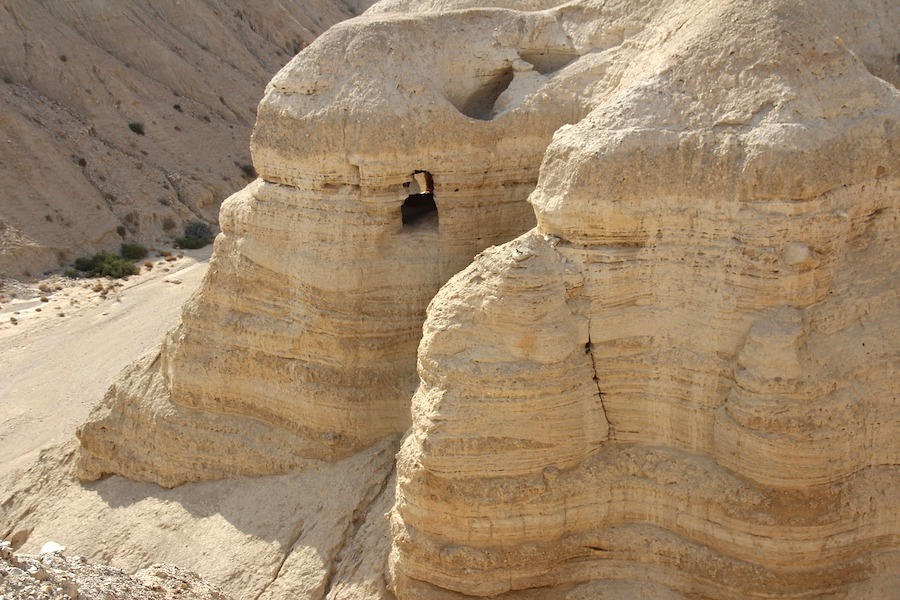
As a tour guide, I have taken many groups to Qumran. I would stand among the ruins, look toward the caves in the cliffs above the Dead Sea, and tell the familiar story.
The scrolls were discovered in the caves in 1947. Professor Eliezer Sukenik of the Hebrew University was among the first scholars to recognize their importance, and in 1948 he associated the scrolls with the Essenes.
The connection between the scrolls and Qumran became even stronger after the archaeological excavations of the site, led by the French Dominican archaeologist Father Roland de Vaux beginning in 1951. His interpretation of Qumran as an Essene settlement became enormously influential.
The story seemed to fit together.
Qumran was the home of the Essenes.
The Essenes were the people behind the scrolls.
They lived here in the desert and eventually hid their library in the caves.
For years, this was the story I knew and the story I told.
But then I encountered the work of Professor Rachel Elior, a leading scholar of Jewish thought and Jewish mysticism at the Hebrew University of Jerusalem, whose research includes the Dead Sea Scrolls and the ancient Jewish priestly tradition.
And suddenly, I began to look at the Dead Sea Scrolls differently.
Continue reading
Her interpretation does not simply change one detail of the story. It raises a much larger question:
What if the people behind the scrolls were not an isolated desert sect at all?
From a Desert Community to a Lost Jewish World
Elior argues that many of the texts should be understood through the history of an ancient priestly tradition associated with the sons of Zadok, the priestly family connected with the Jerusalem Temple.
In this reading, the story is no longer mainly about a small group of religious people who withdrew to Qumran.
It becomes a story about a much larger struggle within Second Temple Judaism: a struggle over the Temple, the priesthood, the Torah, sacred time and who had the authority to determine how Jewish religious life should be ordered.
And that changes the way we look at Qumran.
The Dead Sea Scrolls are much more than ancient copies of the Bible.
They contain biblical manuscripts, prayers, poetry, legal writings, interpretations of Scripture, stories that expand the biblical narratives, and texts dealing with angels, prophecy and the calendar.
Together, they give us a rare glimpse into Jewish life and thought during the final centuries of the Second Temple period.
This was not a world of one single Judaism. There were competing traditions, different interpretations of the Torah, different ideas about religious authority and, as the scrolls reveal, even different calendars.
For Elior, this is the key to understanding the people behind the scrolls.
The conflict was not simply between people who lived in the desert and everyone else. It was connected to a much older conflict over the Jerusalem Temple and the priesthood.
The Priests Who Believed the Order Had Been Broken
The writings associated with the scrolls repeatedly emphasize the importance of the priesthood and the sons of Zadok.
According to Elior’s interpretation, these priests believed that the legitimate priestly order had been displaced during the political upheavals of the Second Temple period.
One of the major turning points came in the second century BCE, when the Seleucid Greek king Antiochus IV Epiphanes intervened in the affairs of Jerusalem and the Temple. The high priesthood became deeply entangled in political struggles, and the Temple itself was caught up in the conflict.
The Hasmoneans, a Jewish priestly family who led the revolt against Seleucid rule, eventually took control of Jerusalem and the Temple. They became both political rulers and religious leaders of Judea.
But there was another problem. The Hasmonean-led Temple establishment followed the lunar calendar that had become the accepted way of determining the Jewish festivals, while the priestly tradition represented in the scrolls followed a solar calendar of 364 days.
The difference was not simply about how many days were in a year.
With the lunar calendar, the beginning of each month was connected to the phases of the moon, and the dates of the festivals could move through the days of the week.
The 364-day solar calendar worked differently. The year was divided into four seasons of 91 days, making exactly 52 weeks. The festivals therefore always fell on fixed days of the week.
For the people who followed the solar calendar, this was part of the divine order. According to the tradition preserved in the scrolls, the calendar had been revealed to Enoch (Hanoch), the biblical figure who appears in Genesis and was later regarded in Jewish tradition as a recipient of heavenly knowledge. In the Book of Enoch, this knowledge is revealed to him by angels.
For them, the calendar was therefore not something human authorities could simply change.
So the disagreement over the calendar was also a disagreement over who had the authority to determine sacred time.
And from the perspective preserved in the scrolls, this was only part of the larger problem.
Who had the right to serve in the Temple?
Who had the authority to interpret the Torah?
Who determines the festivals?
Who decides the calendar?
Who defines the proper order of worship?
The Library Hidden in the Desert
This may also help explain one of the great mysteries of the Dead Sea Scrolls.
Why was such a large collection of Jewish writings hidden in the caves of the Judean Desert?
We cannot know with certainty.
But Professor Elior’s interpretation offers a very different possibility.
If the people behind these writings belonged to a priestly tradition that believed the Jerusalem Temple had been corrupted and that the proper sacred order had been broken, their library would have represented something precious: the written record of the tradition they believed was true.
The scrolls may therefore have been hidden not simply to protect books, but to preserve a priestly library and its knowledge for the future.
The idea is striking.
The Temple in Jerusalem may have been considered compromised, but the written tradition could survive.
The calendar could survive.
The laws could survive.
The prayers and sacred poetry could survive.
The memory of the priesthood could survive.
And it could all be hidden here, in the caves beside Qumran.
This is an interpretation, not something the archaeology can prove. But it gives the caves a very different meaning.
The scrolls were not necessarily the library of a small desert sect.
They may represent the surviving library of a much older Jewish priestly tradition that had lost its place in the Temple.
So, if you are going to visit the Shrine of the Book at the Israel Museum in Jerusalem, and the Great Isaiah Scroll is one of the main attractions you are looking forward to seeing, there is something else to notice on your way inside.
You pass through a cave-like corridor with artifacts discovered at Qumran displayed along the walls. When you come to a flat, disc-shaped stone on your right, lying silently among the many artifacts from Qumran, stop for a moment.
Look closely at it. The stone is flat and roughly circular, with a series of carefully cut grooves and markings across its surface. At first, it may look like a simple stone object, but these markings are what make it so intriguing.
The object has been interpreted as a sophisticated solar calendar device. Its markings appear to represent a fixed pattern of seasons and days that could have been used to keep track of the weeks, Sabbaths and festivals according to a 364-day solar calendar.
What makes it especially interesting is that this fixed pattern corresponds closely to the calendar described in several of the Dead Sea Scrolls. Even if the object was used by an isolated group living in the desert, it could have provided a practical way to follow the same calendar.
You may be looking at one of the remarkable objects that brings the calendar described in the scrolls to life.
The Story Is Bigger Than Qumran
The real discovery, then, may not be only what was found in the caves.
It is the realization that the Jewish world of the Second Temple period was far more diverse, divided and intellectually active than the simple story we often tell suggests.
The scrolls preserve arguments about Scripture, priesthood, the Temple, sacred time and the meaning of Jewish tradition.
They allow us to hear voices that almost disappeared from history.
And this is what makes Professor Elior’s interpretation so striking.
The story of the Dead Sea Scrolls may not simply be the story of Qumran and the Essenes.
It may be part of a much larger story about a Jewish priestly tradition, a struggle over the Temple and a lost world of Jewish thought that survived in writing when the world that produced it disappeared.
The caves may have preserved more than ancient scrolls. They may have preserved the memory of a Jewish world we almost forgot.
A note from the author
The way I have presented Professor Rachel Elior’s ideas in this article is my own understanding of her research and its implications for the Dead Sea Scrolls. It is not intended as a direct summary of everything she has said or published, but as the way I, as a guide, have come to understand and interpret her ideas.

